

Bob and Carol: Resilience in the Rockies
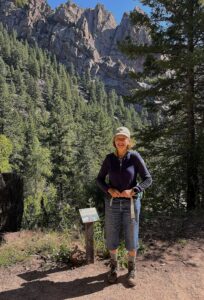
Carol hiking
Telltale Signs
It started on a cold December night. I noticed my wife had opened a window next to our bed to allow some cool air to circulate. But it was below zero outside. I was cold and couldn’t understand why she had opened the window. I tapped her shoulder, which felt damp. Then I brushed against her back. It was soaked with perspiration. The dreaded night sweats had arrived—a telltale sign that Waldenstrom macroglobulinemia (WM) had announced its presence.
Over the course of the next days and weeks, we learned that Carol’s 12-year stint with Monoclonal gammopathy of undetermined significance (MGUS) had transformed into full-blown WM. Her lab results showing an Immunoglobulin M (IgM) reading of approximately 5500 confirmed the diagnosis. What had once been a relatively dormant medical condition was now a reality—one that we had hoped would not come to fruition.
We were fortunate that Carol had tracked her MGUS over the years and was seeing a local oncologist in Boulder, Colorado, who was familiar with WM. As we waited for her next appointment, I decided to research WM online. The results that turned up horrified me— incurable, rare, deadly. These descriptions left me sleepless for a few nights.
New Treatments and My Evolving Role as Caregiver
In a pre-treatment meeting with her oncologist, he described her upcoming bendamustine-rituximab (BR) infusion. We had no inkling of what was in store. Next, we were directed to meet with one of the clinic’s social workers, who enlightened us concerning other ramifications about the treatment and its cost. At this point, I had no idea that I was destined to become a caregiver.
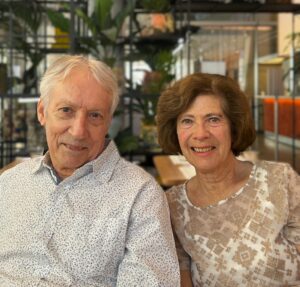
Bob and Carol in New York City
Soon after the appointment, we decided to inform our two daughters about the treatment process to alleviate their concerns as best we could. They didn’t know what to expect but were very supportive.
Like many people thrust into a caregiver role, I was naive about the duties I would need to perform. I had regularly helped around the house and tried to assist in the kitchen, but now I needed to assume a greater portion of the household chores and aid Carol in whatever way I could during her treatment. As infusions, doctor appointments, and recovery days consumed our calendars, my role became clearer.
Our Treatment Journey
One of my new caregiver duties was to help Carol prepare for her doctor’s appointments by developing a list of questions and accompanying her. During these appointments, we both took notes, believing that two sets of ears were better than one. After a few visits, we developed an efficient pre-visit routine and felt well organized. The more we knew about WM and her treatments, the less anxious I became.
My wife’s first BR treatment session proved challenging. Carol experienced a severe reaction to the drugs that sent her body into an uncontrollable spasm. Two nurses and I tried to control her shaking to no avail. Fortunately, her oncologist’s office was located just a few doors from the infusion center. He lowered the flow rate of the drugs and gave her some dexamethasone to calm her frenzied jitters. Her scheduled one to two-hour treatment session morphed into five hours. On our way home from the treatment center, it occurred to me that Carol’s treatment regimen would be much more intense than I imagined. I knew I’d need to do more to help Carol navigate the aftereffects of the treatment.
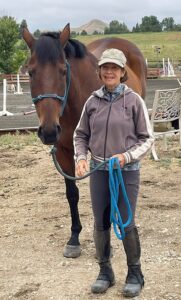
Carol with her horse, Striker
After the initial infusion, the treatment routine was modified, which produced fewer and less severe side effects. After Carol’s monthly infusion, she went home and collapsed into bed for three days. She experienced fatigue that was all consuming. I’d never seen her so exhausted. During the day, I would check on her and notice that she was still sleeping. She must have known that her body was telling her to rest.
During the treatment and recovery time, her appetite was erratic. Carol lost her taste for several foods—fish, certain vegetables, dairy, and, strangely enough, salads, which had been a staple of her diet for decades. Because she had lost so much weight, we realized we didn’t need to worry about calorie intake. Foods she had eaten less frequently in the past now appealed to her. Her appetite for red meat, pasta, and sweets increased. The day after treatment, she routinely requested and devoured a huge cinnamon roll from our local bakery.
Because finding food to satisfy her taste buds was tricky, Carol had difficulty telling me what food sounded appealing. Grocery shopping became a hit-and-miss affair that flustered me upon occasion. I experimented with new foods and recipes with intermittent success. We wanted to ensure that she ate nutritious meals, but if the flavor didn’t agree with her, she would have to convince herself to eat the food or abandon it for something more agreeable.
After a few days of post-treatment rest, Carol was ready to return to her regular life—riding and training horses and part-time work as a consultant. This transformation amazed me, but I felt relieved and inspired by her tenacity to maintain as normal a lifestyle as possible until the next treatment cycle.
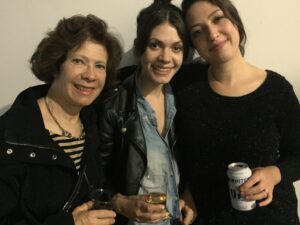
Carol with daughters, Valerie and Jessica
Support Is Essential
During some of Carol’s most difficult recovery periods, our two daughters served as sources of hope and resilience. When she wasn’t feeling well, their visits, timely phone calls, accompaniment to infusion sessions, and comical texts raised her spirits. Our two young grandsons provided entertaining distractions on several occasions. Without our family and close friends, Carol’s recovery would have proved more complicated.
Compared to other caregivers, I felt fortunate. My main duties consisted of shopping, cooking, doing a few household chores, and checking to ensure Carol was doing well after each treatment cycle. Fatigue was the main culprit during her treatment and recovery. We reduced our social activities and revised our travel schedule. Still, we led active lives within the limitation of her treatment cycle.
After six months of BR treatment, Carol’s doctor recommended another three months of maintenance. When the initial maintenance session concluded, the oncologist determined that her reactions to BR and its continued use were not justified. She subsequently experienced 18 months of very good results after terminating the BR. Although my work as a caregiver became easier, I continued to perform more of the daily cooking and other everyday tasks. Knowing that her condition was improving allowed me to concentrate more on my job. Although I always had a lingering worry that WM might reappear, a large weight had been lifted off my shoulders.
IWMF Can Help
A couple of weeks after Carol’s last BR treatment, our oldest daughter phoned to tell us about an organization she had found online: the Leukemia and Lymphoma Society (now called Blood Cancer United). Carol contacted a representative who directed us to the International Waldenstrom’s Macroglobulinemia Foundation (IWMF). We were excited to learn about this organization dedicated to WM. We found information on the IWMF website that was new to us. It was eye opening. As I scoured the WM website and read numerous articles, I grew more hopeful. Various treatments existed, research was being conducted, new drugs were becoming available. Best of all, a community of patients, doctors, health and wellness experts, and support groups existed. We were not alone.
Unfortunately, the efficacy of the BR did not last long, and Carol’s WM relapsed. Fatigue and weight loss returned while her IgM level dramatically increased, forcing her to commence a new treatment. Ibrutinib was the drug of choice this time. Having read about it in IWMF’s magazine, the IWMF Torch, I was hopeful it might offer a better remedy with fewer side effects. After one day on the drug, I noticed a marked change in my wife. She had more energy; her appetite immediately improved, and the oral treatment instead of infusions had a positive psychological effect.
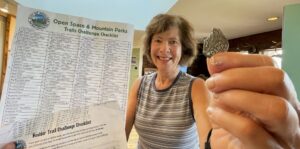
Carol receiving her hiking pin after completing all Boulder trails
During the ibrutinib treatment cycle, my caregiver duties became easier. I worked half-time and subsequently retired just as the pandemic occurred. I was still involved in caregiving, but Carol was more decisive about what she needed and when. The ibrutinib was like a miracle drug. The minor side effects (difficulty maintaining good fingernails and easier bruising) paled in comparison to the BR. Her appetite and some food preferences changed. She no longer liked certain foods, did not crave high calorie pastries, and switched from semi-sweet white wines to more robust red zinfandels on the few occasions she imbibed. Her exercise routine increased dramatically. She challenged herself to hike all 189 trails in the city of Boulder’s open space, a formidable task that allowed her to focus on health, enjoy nature, and accomplish a goal that was paramount in her recovery process. And, of course, her love of horses was stronger than ever. Her successful treatment altered my caregiver load, although our routine for doctor visits remained the same. I assiduously read each issue of the Torch (especially the new research section), attended webinars and in-person forums, and listened to recordings about WM.
Almost three years after starting ibrutinib, Carol’s blood pressure increased. Dr. Matous at the Colorado Blood Cancer Institute tracked the increase and subsequently suggested reducing her dosage by 25%. Her blood pressure stabilized, but lamentably, the ibrutinib started to lose its effectiveness. We were alarmed, but not completely surprised. As her IgM started to rise and fatigue returned, we weren’t sure what options Carol would have. I was prepared to restart full caregiver mode.
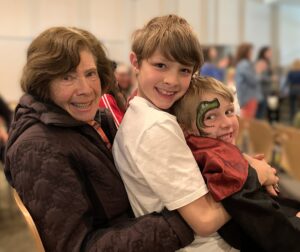
Carol enjoying time with grandsons
Trial Provides New Treatment
In October 2024 while in Chicago, we received a phone call out of the blue from Dr. Matous. He’d been tracking Carol’s numbers and status. He suggested a new clinical trial might prove beneficial as a substitute for the ibrutinib. After a few months of blood tests, a bone marrow biopsy, and research analysis, Carol was admitted to the clinical trial for sonrotoclax, a BCL2 inhibitor.
After more than a year of treatment, Carol is doing well. Her IgM has dropped significantly, and her overall health has improved. Now retired, she continues to ride and train horses while participating in the lives of our grandsons. My caregiver duties have lessened, but my antenna is still on alert for any changes to her condition.
Throughout Carol’s various treatments, I have relied on IWMF as my main resource. I deeply regret that we did not know about IWMF until after Carol’s first treatment, but feel fortunate to have discovered it, nonetheless. Without this organization, my caregiving skills would be more arduous, and my knowledge of WM would be limited to the basics. All the extraordinary resources IWMF provides cannot be overstated. It serves as a clearinghouse for anyone who needs to know about WM. When I now meet someone with WM or a caregiver, my first question is, “Are you familiar with IWMF?” If not, I give them my two-minute pitch.
My journey as a caregiver has probably been more straightforward than what others have experienced. Our health insurance and drug formulary minimized expenses. Our five-minute drive to Carol’s oncologist and the infusion center could not have been more convenient. Even the longer drive we now make once a month to Denver takes less than an hour. In addition, we have the further benefit of visiting our grandsons when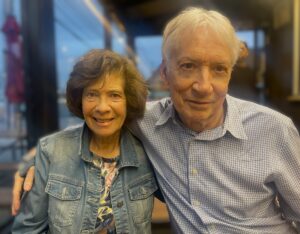 we occasionally stay overnight at our daughter’s house prior to a clinical trial appointment. Yet WM has presented challenges. The uncertainty WM creates with respect to treatment, side effects, diet, socializing, travel, and everyday living can pose difficulties and prompt anxiety. For me, organization and planning have been essential. Those aspects of caregiving that I can control help mitigate most uncertainties.
As we continue to navigate WM, I am thankful that Carol possesses great resilience and perseverance; otherwise, our journey down this road would have been more challenging. And as we progress, I’m reminded of Sheryl Crow’s lyrics, “Every day is a winding road, I get a little bit closer.”
Bob Amend
Boulder, CO
April 2026